DRAFT NATIONAL AVIATION POLICY-2007
1. Air Transport plays a key role in the promotion of trade, tourism & economic growth of a country. Pakistan with a population of 160 million and GDP growth rate of about 7% per annum has potential to surpass the existing air traffic growth rate of about 8% per annum. The growing domestic and international aviation sector in Pakistan needs an environment which not only serves the public interest and the aviation sector but also supplements the growth of trade, tourism and national economy. The policy is aligned with national trade corridor, which encompasses government’s vision to route international trade, tourism and passenger traffic through Pakistan. It also aims to provide the public direct connections from Pakistan while ensuring safe, affordable and quality services.
VISION
2. A progressive, liberalized, and efficient aviation sector based on competition and fair opportunities; regulated to safeguard public interest, provide impetus to national economy and to achieve international standards of safety and security.
3. Objectives
(a) To serve public interests.
(b) To comply with ICAO standards of Safety, Security and Regulatory.
(c) To promote aviation sector in the country.
(d) To encourage development and maximum use of aviation infrastructure.
(e) To regulate standards of services of airports and airlines.
Paid Up Capital & Fleet Registration
4. Airline licenses granted to financially unsound operators gave rise to opportunism. It also paved the way for foreign companies/airlines to exploit our market through wet leasing without investing in the development of local infrastructure and human resource. Safety and security oversight was compromised and employment opportunities for Pak nationals were curtailed due to wet leasing. The requirement of enhanced paid up capital, fleet registration, its size and restriction on wet lease operations on foreign registered aircraft in the country will ensure better safety oversight besides giving boost to local job market and training activities. Therefore:
(a) The paid up capital for Regular Public Transport license shall be 500 million rupees, which shall be reviewed periodically by CAA Board.
(b) Fleet registration in Pakistan by all operators shall be mandatory.
(c) Requirement of minimum fleet size for a Regular Public Transport (RPT) license holder shall be as follows:
(i) For domestic operations at least 03 airworthy aircraft with 02 aircraft operational at all times.
(ii) For international operations at least 04 airworthy aircraft with 03 aircraft operational at all times.
(d) There shall be no permanent addition to capacity by inducting foreign registered aircraft on wet lease. Temporary induction of foreign registered aircraft on wet lease will be permitted as under:
(i) For Hajj operations maximum 90 days.
(ii) For Umrah operations maximum 60 days in a calendar year and up to 33% of the registered fleet capacity.
(iii) For any other reason maximum 90 days in a calendar year and up to 25% of the registered fleet capacity.
(e) The calendar age of the passenger aircraft shall not be more than 18 years at the time of induction.
Notes:
(a) All operators currently operating foreign registered aircraft shall register 100% fleet in Pakistan, by June 30, 2007.
(b) To overcome the current shortage of pilots, foreign captains may be employed on Pakistan registered aircraft up to June 30, 2008 however; co-pilots / first officers shall have to be Pakistani nationals.
5. Tariffs
(a) CAA as a regulator shall oversee, intervene and mediate in case of predatory pricing / practices in the interest of traveling public.
(b) All fares shall continue to remain deregulated
(c) CAA shall make rules, regulations and procedures to redress public grievances and adjudicate these on merit, in public interest.
Domestic Operations
6. A liberalised market structure and reliance on competition is the best way to deliver efficient aviation services for the benefit of consumers. This would be achieved through bare minimum government-imposed restrictions on the commercial behaviour of airlines. In order to ensure that domestic operations are adequately spread and people of remote areas have reasonable access to air services; following minimum requirement of operations on domestic routes (classification of routes attached as annexure-A) by Pakistani airlines shall be mandatory:
(a) Minimum 10 weekly frequencies on trunk routes and,
(b) Minimum 02 weekly frequencies on primary routes and,
(c) Minimum 02 weekly frequencies on secondary routes.
Note: Operations on secondary routes for new airlines shall not be mandatory for a period 0f 03 years, starting from the date of operations.
International Operations
7. The interest of users will be best served if airlines are free to compete according to their commercial judgment:
(a) Pakistani airlines shall be eligible to commence operations on international routes after one year of continued satisfactory operations on domestic routes. However, this restriction will not be applicable to airlines acquiring more than 50% of the fleet on ownership basis.
(b) Airlines satisfactorily meeting the requirements of domestic operations and fleet registration shall be free to operate on international routes, without formal allocation of frequencies by the regulatory authority, to countries pursuing open skies or where there are no bilateral constraints on capacity.
(c) Where there are bilateral constraints on capacity; the available capacity shall be allocated amongst the competing airlines proportionate to their capacity floated on domestic routes in the previous two scheduling periods. Additionally airlines’ regularity, punctuality, safety record and fleet registration shall also be quantified and considered while allocating capacity.
(d) Capacity unutilized by an airline for one scheduling period and with no plans to operate in the next scheduling period shall be allocated to another Pakistani airline desirous of utilizing it.
(e) Where there are bilateral constraints on multiple designation of airlines the designation of an offline Pakistani carrier shall be replaced with an airline desirous of operating to that destination.
8. Charter Operations
(a) Domestic charter operation will be allowed to Pakistani operators using Pakistan registered aircraft including helicopters, flown by Pakistani pilots.
(b) International Charters originating from Pakistan will be allowed to Pakistani operators only.
(c) CAA shall formulate and implement liberalized policy for Pakistani and foreign operators for charter operations on international routes.
Bilateral Arrangements
9. Restrictive bilateral agreements raise prices and suppress aviation growth. Liberal air services agreements remove limitations on airlines’ freedom to increase service, lower fares and promote economic growth. The potential of Karachi airport to develop into a business hub, Lahore airport as a business cum tourist hub & Islamabad airport as tourist hub needs to be exploited. In addition to providing direct and convenient connections to the local traffic from these airports, Pakistan is strategically located to route the flow of international traffic from East to Europe and North America by liberalizing bilateral agreements. Following shall, therefore, be the essential features of our future bilateral initiatives:
(a) Passenger Services
(i) Pakistan shall liberalize bilateral arrangements on reciprocal basis with our bilateral partners to provide minimum daily direct service from Karachi, Lahore and Islamabad to destinations in Europe, North America and Africa and to destinations towards East.
(ii) Selective fifth freedom traffic rights shall be granted to legacy carriers on reciprocal basis.
(iii) While finalizing new ASAs, multiple airlines designation clause and article on code-share shall be incorporated.
(iv) There shall be no mandatory commercial agreements as part of bilateral agreements. However; airlines shall be free to enter into such co-operative marketing arrangements as are mutually agreeable, which will be outside of air services agreements.
(v) Air services agreements shall be negotiated and implemented by DG Civil Aviation Authority within the framework of National Aviation Policy.
(b) Cargo Services
(i) Pakistan shall continue to follow open skies policy for cargo operations.
(ii) Karachi and Gwadar shall also be promoted as transshipment hubs.
(iii) Cargo villages shall be established on public-private partnership at Karachi, Lahore, Islamabad & Gwadar and linked with NTC.
PROMOTION / DEVELOPMENT OF AVIATION SECTOR
10. CAA Pakistan has embarked upon a restructuring program which aims to separate the regulatory, air traffic services and commercial functions to achieve the highest safety standards, encourage development of merchant airports and to efficiently absorb investment in the aviation sector. The process is in the advanced stages and after completion shall make the CAA more efficient, responsive and above all capable to ensure international standards of safety.
Airports
(i) Airports shall be made safer & user friendly while ensuring world class airport infrastructure in accordance with demand, ensuring maximum capacity utilization and efficient management by involving private sector.
(ii) Construction of new commercial airports will be permitted to meet the growth in air traffic.
(iii) Private sector shall be free to construct and operate new / existing airports / airstrips / helipads / heliports including cargo complexes on BOO, BOT or any other management arrangement and to raise non aeronautical revenues from these premises.
(iv) CAA will ensure fair and equal opportunities for public and private sector airports. Private sector shall be encouraged to develop additional revenue streams i.e. passenger charges cargo levies and commercial activities, however, CAA shall have the responsibility of economic oversight of all airports.
11. Commercialization of Airports
(a) CAA to develop “airport cities†including hotels on public private partnership at all major airports.
(b) Vacant land at airports shall be evaluated and developed for construction of aviation related facilities (e.g. cargo complexes and aircraft maintenance facilities, etc).
(c) Land at remote and non operational airports shall be utilized for non aeronautical commercial and recreational purposes. CAA shall formulate land lease policy to make it commercially viable for the private investors.
Note: Development, restructuring and commercialization of CAA, its land and airports is to be done in line with goals and objectives of government’s National Transport Master Plan.
12. Import of Aircraft
(a) DG CAA shall permit the induction of fixed wing aircraft as well as helicopters of all weight categories on lease and purchase basis, including private owned aircraft through a simplified procedure to be published in the form of an Air Navigation Order (ANO).
(b) Security clearance for the import of fixed wing aircraft and helicopters on purchase basis shall not be required in respect of Pakistani companies and nationals holding valid licenses. When first time security clearance is required the process shall be completed by security agencies within 30 days. If there is no response from security agencies it will be assumed that the agencies have no objection on the import of aircraft.
13. Aviation Support Services
(a) Maintenance
To encourage maintenance activities, CAA Pakistan shall facilitate setting up of maintenance infrastructure / facilities by private operators and maintenance companies. Private sector participation shall also be encouraged to establish infrastructure including engine overhaul and repairs.
(b) Ground Handling Agencies
(i) At all public and private airports competition between Ground Handling agencies shall be mandatory. CAA shall ensure strict safety and quality oversight of all such agencies.
(ii) Pakistani carriers shall be free to undertake self-handling to improve services and reduce cost.
Airport Charges
14. The infrastructure constraints at some of our airports lead to aircraft parking problems and congestion in passenger lounges leading to security concerns. This problem can be partially resolved by introducing variable charges at these airports to stagger the flights evenly over a period of 24 hours while ensuring that at other airports the charges remain competitive in the region. Therefore;
(a) CAA user charges shall be competitive in the region.
(b) For optimum utilization of airports user charges will be reviewed periodically on the basis of peak and off peak period.
(c) Airlines operating to secondary routes shall be exempted from landing and housing charges.
General Aviation and Helicopter Operations
15. About 64 % of Pakistani population lives in rural areas, with little or no access to air travel even in emergency, for the want of air strips, heliports / helipads and suitable aircraft to commute to/from remote areas. There are a fairly large number of cities which are developed to adopt the concept of air taxi and private owned aircraft for commuting. Therefore:
(a) CAA shall liberalize procedures for acquisition and operation of aircraft, including helicopters, micro-light aircraft and hot air balloons to encourage travel and sports activities.
(b) CAA shall encourage and promote use of helicopters for tourism, emergency operations and adventure sports. No charges shall be imposed by CAA for such operations.
(c) CAA shall formulate liberalized guidelines in consultation with users to promote and encourage private investment in flying clubs, air taxi service, private ownership of aircraft, and Aero-sports activities i.e hang-gliding, ballooning, heli-skiing, Para-jumping etc.
(d) Flying Clubs
Flying Clubs shall be facilitated to overcome shortage of pilots in the country i.e. to develop airstrips outside control zones of major airports for exclusive use of training flights and to lease CAA facilities to flying clubs where available.
Civil Military Co-ordination
16. CAA shall coordinate with military users for efficient sharing of civil and military airspace to make the operations cost effective and convenient for all operators.
Air Traffic Services
17. CAA Pakistan to establish state of the art Communication, Navigation & Surveillance (CNS) and Air Traffic Management (ATM) systems in the country.
Human Resource Development
18. Academies / institutions in collaboration with foreign universities and with private sector shall be set up to develop human resource of world class standard for national and international airports, airlines and regulators.
Taxes & Duties on Import of Aviation Related Equipment
19. The current policy of 0% duties and taxes on import of aircraft of all weight categories, engines and spares by all Pakistani operators, CAA & maintenance companies shall continue. The same concession shall also be extended to Civil Aviation Authority and private operators for the import of Communication, Navigation & Surveillance (CNS), Air Traffic Management (ATM) systems and Fire Fighting vehicles & equipment including training equipment like all types of simulators, technical publications & manuals imported by CAA as well as operators and maintenance companies (Annex-B).
(a) Tax holiday shall be granted to maintenance companies and flying training schools for 10 years.
(b) Security equipment and weapons imported for use by Airport Security Force and CAA shall be exempted from all taxes and custom duties.
(c) Government shall rationalize and reduce taxes chargeable to passengers on international and domestic routes.
(d) Government shall exempt all taxes and duties on air ticket on secondary destinations. The same privileges shall be extended to operators of small aircraft and helicopters.
Consumer Protection
20. Passenger interests and development of aviation sector shall be at the core of all CAA policies / rules and regulations, therefore:
Discussion Point (a)
(a) To make airports efficient and passenger friendly the administrative control over all the functionaries of the airports shall rest with DG CAA, which shall be exercised thorough Airport Managers in deciding mundane local issues related to Customs, Immigration, Intelligence Agencies & ASF etc.
(b) CAA Pakistan shall make institutional arrangements at different levels for constant interaction with and amongst all categories of users for implementation of policy and constant improvement in services.
(c) Suitable mechanisms shall be set up to monitor standards of services and to redress grievances.
Implementation of Policy
21. Director General CAA shall implement National Aviation Policy
Note: CAA earned the revenue of about Rs. 7.8 million on account of embarkation fee & landing charges for operations on 20 secondary airports in 2006.
The government received about Rs. 14 million on account of sales tax and airport tax from 20 airports in 2006.
Annexure-A
Draft Aviation Policy-2007
CATEGORIES OF ROUTES
1. Trunk Routes
Any city pair of the following airports would form a trunk route:
Karachi, Lahore, Islamabad, Peshawar and Quetta
2. Primary Routes
Air link with the following destinations would form a primary route:
Multan, Faisalabad, Sukkur, D.G. Khan, Rahim Yar Khan, Bhawalpur, Nawabshah, Gwadar, Pasni and Jacobabad
3. Secondary Routes (Turbo Prop Operable)
Air link with the following destinations would form a secondary route:
Skardu, Moenjodaro, Zhob, Saidu Sharif, , Dalbadin, Bannu, Parachanar, Sehwan Sharif, D.I. Khan, Hyderabad, Ormara, Khuzdar, Rawalakot, Muzaffarabad, Chitral, Gilgit, Panjgur, Turbat and Jiwani
Annexure-B
Draft Aviation Policy-2007
LIST OF THE EQUIPMENT EXEMPTED FROM IMPORT DUTIES AND TAXES
Government duties and taxes on import of new / used operational equipment used for the provision of air traffic services & training shall be exempted.
Communication & Broadcast Equipment:
UHF, VHF & HF radios, ATIS and related equipment, spare parts including all satellite based communication equipment like remote radio stations & data link i.e. VDL & CPDLC and/or any other communication equipment used for the provision of air traffic services shall be exempted.
Navigation Equipment:
VOR, NDB, ILS Satellite based instrument landing system and/or any other Satellite based navigation equipment used for the provision of air traffic services shall be exempted.
Surveillance Equipment:
Radars and satellite based surveillance equipment like ADS (C) & ADS (B) and/or any other surveillance equipment used for the provision of air traffic services shall be exempted.
Rescue and Fire fighting Equipment:
All fire fighting vehicles, operational vehicles used on Air Side, rescue & fire equipment including spare parts shall be exempted from taxes and duties.
Display System:
FIDS (Flight Information Display System) shall be exempted from all duties and taxes.
Training Equipment:
All training equipment including simulators and their spare parts shall be exempted from taxes and duties.
Calibration Equipment
All equipment being utilized for the purpose of calibrating Radar & Radio Navigational Aids shall be exempted from taxes and duties.
Aeronautical Publications
All Aeronautical publications shall be exempted from taxes and duties.
Source: CAA - Pakistan
CAA-Pakistan releases Draft National Aviation Policy - 2007
-
Abbas Ali

- Site Admin
- Posts: 56819
- Joined: Thu Aug 05, 2004 6:52 pm
- Location: Pakistan
CAA-Pakistan releases Draft National Aviation Policy - 2007
Dil Dil Pakistan... Jaan Jaan Pakistan
See you at:

See you at:
-
Abbas Ali
- Site Admin
- Posts: 56819
- Joined: Thu Aug 05, 2004 6:52 pm
- Location: Pakistan
Click here to read previous National Aviation Policy.
Dil Dil Pakistan... Jaan Jaan Pakistan
See you at:
See you at:
-
Abbas Ali
- Site Admin
- Posts: 56819
- Joined: Thu Aug 05, 2004 6:52 pm
- Location: Pakistan
Private sector may build, operate airports
By Saad Hasan
KARACHI: A proposed aviation policy that seeks to liberalise the country’s aviation industry and promote competition among domestic airlines has allowed the private sector to construct and operate commercial airports to meet expected growth in air traffic.
According to the draft National Aviation Policy 2007, the private sector will be allowed to construct and operate airports and generate non-aeronautical revenues.
Director General Civil Aviation Authority (CAA) Farooq Rehmatullah, who has spearheaded the aviation policy and ambitious reforms in the CAA itself, said the private development of airports was aimed at enhancing connectivity of rural areas with the rest of the country.
“Sixty per cent of the population is based in rural areas. Their purchasing power and per capita income has increased but they have to travel long distances to reach the airports,†he said, adding airstrips in their areas would generate feeder traffic for bigger airports.
Specifically citing semi-industrial cities like Gujrat and Sahiwal, he said there was a lot of passenger traffic but no airports. “These airstrips can be used by 12 or 15-seater fixed-wing aircraft to provide feeder service to main hubs.â€ÂÂ
The policy draft that has been uploaded on the CAA’s website for public feedback also envisages selective fifth freedom traffic rights to legacy carriers on reciprocal basis.
Rehmatullah explained this would allow airlines like Lufthansa and Cathay Pacific Airways to operate connecting flights through Pakistan.
“Coming from east and going to west, these airlines would drop and pick passengers at Karachi and Lahore.â€ÂÂ
Asked as to how this would safeguard the interests of domestic carriers, he said: “While setting the objectives of this (draft) policy we asked; should we serve the PIA (Pakistan International Airlines) or the public?†The latter was given priority, he added.
The draft policy has also made it mandatory for Pakistani airlines to register their aircraft domestically and stopped them from permanently inducting foreign registered aircraft on wet lease.
It says temporary induction of wet leased aircraft, which are provided by the lessor along with crew, maintenance and insurance cover, will be allowed for a limited period of time.
“Requirement of enhanced paid-up capital, fleet registration, its size and restriction on wet lease operations on foreign registered aircraft in the country will ensure better safety oversight besides giving boost to local job market and training activities,†it said.
While paid-up capital for Regular Public Transport licence has been increased to Rs500 million, temporary induction of aircraft on wet lease has been allowed for Hajj and Umrah operations.
Aircraft on wet lease are permitted for any other reason “for maximum 90 days and up to 25pc of the registered fleet capacity.â€ÂÂ
Source: The News
By Saad Hasan
KARACHI: A proposed aviation policy that seeks to liberalise the country’s aviation industry and promote competition among domestic airlines has allowed the private sector to construct and operate commercial airports to meet expected growth in air traffic.
According to the draft National Aviation Policy 2007, the private sector will be allowed to construct and operate airports and generate non-aeronautical revenues.
Director General Civil Aviation Authority (CAA) Farooq Rehmatullah, who has spearheaded the aviation policy and ambitious reforms in the CAA itself, said the private development of airports was aimed at enhancing connectivity of rural areas with the rest of the country.
“Sixty per cent of the population is based in rural areas. Their purchasing power and per capita income has increased but they have to travel long distances to reach the airports,†he said, adding airstrips in their areas would generate feeder traffic for bigger airports.
Specifically citing semi-industrial cities like Gujrat and Sahiwal, he said there was a lot of passenger traffic but no airports. “These airstrips can be used by 12 or 15-seater fixed-wing aircraft to provide feeder service to main hubs.â€ÂÂ
The policy draft that has been uploaded on the CAA’s website for public feedback also envisages selective fifth freedom traffic rights to legacy carriers on reciprocal basis.
Rehmatullah explained this would allow airlines like Lufthansa and Cathay Pacific Airways to operate connecting flights through Pakistan.
“Coming from east and going to west, these airlines would drop and pick passengers at Karachi and Lahore.â€ÂÂ
Asked as to how this would safeguard the interests of domestic carriers, he said: “While setting the objectives of this (draft) policy we asked; should we serve the PIA (Pakistan International Airlines) or the public?†The latter was given priority, he added.
The draft policy has also made it mandatory for Pakistani airlines to register their aircraft domestically and stopped them from permanently inducting foreign registered aircraft on wet lease.
It says temporary induction of wet leased aircraft, which are provided by the lessor along with crew, maintenance and insurance cover, will be allowed for a limited period of time.
“Requirement of enhanced paid-up capital, fleet registration, its size and restriction on wet lease operations on foreign registered aircraft in the country will ensure better safety oversight besides giving boost to local job market and training activities,†it said.
While paid-up capital for Regular Public Transport licence has been increased to Rs500 million, temporary induction of aircraft on wet lease has been allowed for Hajj and Umrah operations.
Aircraft on wet lease are permitted for any other reason “for maximum 90 days and up to 25pc of the registered fleet capacity.â€ÂÂ
Source: The News
Dil Dil Pakistan... Jaan Jaan Pakistan
See you at:
See you at:
-
Abbas Ali
- Site Admin
- Posts: 56819
- Joined: Thu Aug 05, 2004 6:52 pm
- Location: Pakistan
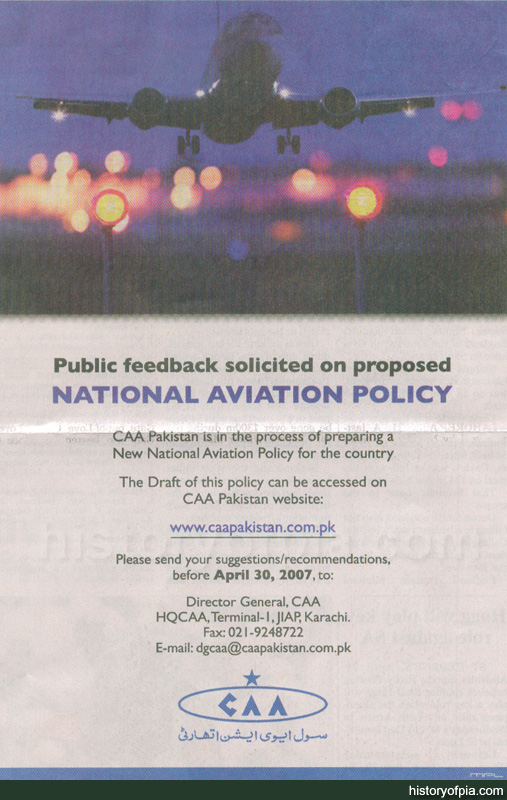
CAA-Pakistan is accepting suggestions/recommendations for new National Aviation Policy.
In today’s (April 22, 2007) newspaper:
On the Net: CAA-Pakistan
In today’s (April 22, 2007) newspaper:
On the Net: CAA-Pakistan
Dil Dil Pakistan... Jaan Jaan Pakistan
See you at:
See you at:
-
behramjee
- Registered Member
- Posts: 893
- Joined: Mon Aug 09, 2004 7:52 pm
- Location: Toronto, Canada
My 2 suggestions which will be emailed to them are :CAA-Pakistan is accepting suggestions/recommendations for new National Aviation Policy.
1. To include Middle East state airlines too in the list of airlines that can fly daily to LHE/ISB and PEW alongside KHI. Unfortunately only European, North American and East Asian airlines have been mentioned and I feel thats done on purpose to protect PIAs lucurative market share on Northern Pakistan-Gulf routes.
2. Reduce CAA ground handling and landing charges similar to those charged by AUH and DXB i.e. 50% less which would automatically entice airlines to restart PAK flights. To incite, EU carriers, an incentive of 6 months free ground handling charges should be initiated which KUL airport does too...infact KUL had a one year free landing fees policy to get new airlines flying there or current airlines introduce more flights

-
Cloud2084
- Registered Member
- Posts: 1
- Joined: Mon Apr 23, 2007 6:43 pm
Subsidy on fuel for flying clubs
In earlier times Flying club students used to get subsidy in terms of flying hours, but it was grossly misused by the CFIs of those times..instead the Govt. should start giving subsidy on fuel only to the flying clubs.
Yearly flying hours flown by the flying schools should be the criteria, CAA should give a waiver/rebate or aeronautical charges/ CAA dues. At the end of each financial year, CAA charges should be adjusted with the amount equivalent to the tax levied on aviation fuel comsumed for flying training.
This will not only reduce the flying training cost, hence making it more affordable & attractive to the general public. On one hand our flying schools will churn out more pakistani pilots, moreover, it will attract foreign students aswell.
Yearly flying hours flown by the flying schools should be the criteria, CAA should give a waiver/rebate or aeronautical charges/ CAA dues. At the end of each financial year, CAA charges should be adjusted with the amount equivalent to the tax levied on aviation fuel comsumed for flying training.
This will not only reduce the flying training cost, hence making it more affordable & attractive to the general public. On one hand our flying schools will churn out more pakistani pilots, moreover, it will attract foreign students aswell.
-
javed
- Registered Member
- Posts: 425
- Joined: Tue Apr 03, 2007 5:01 pm
- Location: Toronto, Canada
behramjee wrote:My 2 suggestions which will be emailed to them are :CAA-Pakistan is accepting suggestions/recommendations for new National Aviation Policy.
1. To include Middle East state airlines too in the list of airlines that can fly daily to LHE/ISB and PEW alongside KHI. Unfortunately only European, North American and East Asian airlines have been mentioned and I feel thats done on purpose to protect PIAs lucurative market share on Northern Pakistan-Gulf routes.
Yes, Pakistan has every right to protect its economy from unlawfully subsidized airlines of Gulf countries. Pakistan should infact slap anti-dumping duties or other penalties against the Gulf airlines under WTO/GATT rules. But then like other political impossibilities, this is also not possible for GoP.
-
Abbas Ali
- Site Admin
- Posts: 56819
- Joined: Thu Aug 05, 2004 6:52 pm
- Location: Pakistan
New aviation policy proposes 100pc local registration: Airlines’ fleet
By Amin Ahmed
RAWALPINDI, April 30: The Civil Aviation Authority (CAA) has proposed that all airlines currently operating foreign registered aircraft will register their 100 per cent fleet in Pakistan by June 30, 2007, according to the draft national aviation policy 2007.
To overcome the current shortage of pilots, foreign captains may be employed on Pakistan registered aircraft up to June 30, 2008. However, co-pilots and first officers will have to be Pakistani nationals.
Under the policy, Pakistani airlines will be eligible to commence operations on international routes after one year of continued satisfactory operations on domestic routes. However, this restriction will not be applicable to airlines acquiring more than 50 per cent of the fleet on ownership basis.
The draft policy states the growing domestic and international aviation sector in Pakistan needs an environment, which not only serves public interest and the aviation sector but also supplements the growth of trade, tourism and national economy. The policy is aligned with national trade corridor, which encompasses government’s vision to route international trade, tourism and passenger traffic through Pakistan. It also aims to provide the public direct connections from Pakistan while ensuring safe, affordable and quality services, the policy document states.
A liberalised market structure and reliance on competition is the best way to deliver efficient aviation services for the benefit of consumers. This would be achieved through bare minimum government-imposed restrictions on the commercial behaviour of airlines.
In order to ensure that domestic operations are adequately spread and people of remote areas have reasonable access to air services, the CAA has made mandatory of minimum 10 weekly frequencies on trunk routes; minimum two weekly frequencies on primary routes; and minimum two weekly frequencies on secondary routes as minimum requirement of operations on domestic routes by Pakistani airlines.
However, operations on secondary routes for new airlines will not be mandatory for a period of three years, starting from the date of operations.
Airlines satisfactorily meeting the requirements of domestic operations and fleet registration will be free to operate on international routes, without formal allocation of frequencies by the regulatory authority, to countries pursuing open skies or where there are no bilateral constraints on capacity.
Where there are bilateral constraints on capacity; the available capacity shall be allocated amongst the competing airlines proportionate to their capacity floated on domestic routes in the previous two scheduling periods. Additionally airlines’ regularity, punctuality, safety record and fleet registration shall also be quantified and considered while allocating capacity.
Capacity unutilised by an airline for one scheduling period and with no plans to operate in the next scheduling period shall be allocated to another Pakistani airline desirous of utilising it.
Where there are bilateral constraints on multiple designation of airlines the designation of an offline Pakistani carrier will be replaced with an airline desirous of operating to that destination.
Domestic charter operation will be allowed to Pakistani operators using Pakistan registered aircraft including helicopters, flown by Pakistani pilots.
International charters originating from Pakistan will be allowed to Pakistani operators only. The CAA will formulate and implement liberalised policy for Pakistani and foreign operators for charter operations on international routes.
The potential of Karachi airport to develop into a business hub, Lahore airport as a business cum tourist hub and Islamabad airport as a tourist hub needs to be exploited. Pakistan is strategically located on the international route, liberal arrangements with our bilateral partners, in addition to providing direct and convenient connections to the local traffic from these airports, shall also help to route the flow of international traffic from East to Europe and North America through Pakistan.
Source: DAWN
By Amin Ahmed
RAWALPINDI, April 30: The Civil Aviation Authority (CAA) has proposed that all airlines currently operating foreign registered aircraft will register their 100 per cent fleet in Pakistan by June 30, 2007, according to the draft national aviation policy 2007.
To overcome the current shortage of pilots, foreign captains may be employed on Pakistan registered aircraft up to June 30, 2008. However, co-pilots and first officers will have to be Pakistani nationals.
Under the policy, Pakistani airlines will be eligible to commence operations on international routes after one year of continued satisfactory operations on domestic routes. However, this restriction will not be applicable to airlines acquiring more than 50 per cent of the fleet on ownership basis.
The draft policy states the growing domestic and international aviation sector in Pakistan needs an environment, which not only serves public interest and the aviation sector but also supplements the growth of trade, tourism and national economy. The policy is aligned with national trade corridor, which encompasses government’s vision to route international trade, tourism and passenger traffic through Pakistan. It also aims to provide the public direct connections from Pakistan while ensuring safe, affordable and quality services, the policy document states.
A liberalised market structure and reliance on competition is the best way to deliver efficient aviation services for the benefit of consumers. This would be achieved through bare minimum government-imposed restrictions on the commercial behaviour of airlines.
In order to ensure that domestic operations are adequately spread and people of remote areas have reasonable access to air services, the CAA has made mandatory of minimum 10 weekly frequencies on trunk routes; minimum two weekly frequencies on primary routes; and minimum two weekly frequencies on secondary routes as minimum requirement of operations on domestic routes by Pakistani airlines.
However, operations on secondary routes for new airlines will not be mandatory for a period of three years, starting from the date of operations.
Airlines satisfactorily meeting the requirements of domestic operations and fleet registration will be free to operate on international routes, without formal allocation of frequencies by the regulatory authority, to countries pursuing open skies or where there are no bilateral constraints on capacity.
Where there are bilateral constraints on capacity; the available capacity shall be allocated amongst the competing airlines proportionate to their capacity floated on domestic routes in the previous two scheduling periods. Additionally airlines’ regularity, punctuality, safety record and fleet registration shall also be quantified and considered while allocating capacity.
Capacity unutilised by an airline for one scheduling period and with no plans to operate in the next scheduling period shall be allocated to another Pakistani airline desirous of utilising it.
Where there are bilateral constraints on multiple designation of airlines the designation of an offline Pakistani carrier will be replaced with an airline desirous of operating to that destination.
Domestic charter operation will be allowed to Pakistani operators using Pakistan registered aircraft including helicopters, flown by Pakistani pilots.
International charters originating from Pakistan will be allowed to Pakistani operators only. The CAA will formulate and implement liberalised policy for Pakistani and foreign operators for charter operations on international routes.
The potential of Karachi airport to develop into a business hub, Lahore airport as a business cum tourist hub and Islamabad airport as a tourist hub needs to be exploited. Pakistan is strategically located on the international route, liberal arrangements with our bilateral partners, in addition to providing direct and convenient connections to the local traffic from these airports, shall also help to route the flow of international traffic from East to Europe and North America through Pakistan.
Source: DAWN
Dil Dil Pakistan... Jaan Jaan Pakistan
See you at:
See you at:
-
Abbas Ali
- Site Admin
- Posts: 56819
- Joined: Thu Aug 05, 2004 6:52 pm
- Location: Pakistan
Aviation Policy - Defence Ministry, CAA Directed To Finalise New Draft
Asim Rana
ISLAMABAD: Senate Standing Committee on Defence and Defence Production Wednesday directed the ministry of defence and Civil Aviation Authority (CAA) to finalise a new draft on the Aviation Policy before the end of this year in consultation with all stakeholders. While formulating the new policy, international standards must be fulfilled and they must replicate and emulate best practices to facilitate the people, Senator Nisar A. Memon said.
The new policy should not only ensure a fair and healthy competition among the airlines but also endeavor to meet global standards with regard to passenger safety and comfort, the meeting stressed. The Senate body asked the government to undertake rationalization of taxes on air travel, which it felt were presently too high and discouraging the middle and lower income groups.
The committee asked PIA to furnish a complete and comprehensive report of damage assessment to the Airlines as a result of the ban placed on its planes by the EU and explain the reasons as to why the CAA and PIA responded so late to the deficiencies pointed out by the EU and why they did not try to overcome and rectify those in the first instance.
The members of the committee, expressed their dissatisfaction over the facilities presently available at the airports adding that these were substandard and need much improvement.
"Passenger lounges are not up to the mark, the staff deputed at the airports is generally not very cooperative and courteous, cleanliness also leaves a lot to be desired, Similarly nobody cares for passengers, who are stranded at the airports in case of cancellation of flights," they maintained.
Earlier, CAA Director General Farooq Abdullah gave a detailed presentation to the committee. He said it aimed at ensuring safe and efficient Civil Aviation operations in the country in conformity with ICAO standards.
It also strives for improving terminal facilities and removing bottlenecks for passengers, making Pakistani airports passenger-friendly besides promoting and encouraging tourism in the country.
He said their vision was a progressive, liberalised and efficient aviation sector based on competition and fair opportunities, regulated to safeguard public and national interest, provide impetus to the national economy and to achieve international standards of safety and security. The meeting was attended, among others, by senators Mushahid Hussain Sayed, Syed Dilawar Abbas, Naeem Hussain Chattha, Asif Jatoi and Rukhsana Zuberi, besides the senior officials.
Source: The Post
Asim Rana
ISLAMABAD: Senate Standing Committee on Defence and Defence Production Wednesday directed the ministry of defence and Civil Aviation Authority (CAA) to finalise a new draft on the Aviation Policy before the end of this year in consultation with all stakeholders. While formulating the new policy, international standards must be fulfilled and they must replicate and emulate best practices to facilitate the people, Senator Nisar A. Memon said.
The new policy should not only ensure a fair and healthy competition among the airlines but also endeavor to meet global standards with regard to passenger safety and comfort, the meeting stressed. The Senate body asked the government to undertake rationalization of taxes on air travel, which it felt were presently too high and discouraging the middle and lower income groups.
The committee asked PIA to furnish a complete and comprehensive report of damage assessment to the Airlines as a result of the ban placed on its planes by the EU and explain the reasons as to why the CAA and PIA responded so late to the deficiencies pointed out by the EU and why they did not try to overcome and rectify those in the first instance.
The members of the committee, expressed their dissatisfaction over the facilities presently available at the airports adding that these were substandard and need much improvement.
"Passenger lounges are not up to the mark, the staff deputed at the airports is generally not very cooperative and courteous, cleanliness also leaves a lot to be desired, Similarly nobody cares for passengers, who are stranded at the airports in case of cancellation of flights," they maintained.
Earlier, CAA Director General Farooq Abdullah gave a detailed presentation to the committee. He said it aimed at ensuring safe and efficient Civil Aviation operations in the country in conformity with ICAO standards.
It also strives for improving terminal facilities and removing bottlenecks for passengers, making Pakistani airports passenger-friendly besides promoting and encouraging tourism in the country.
He said their vision was a progressive, liberalised and efficient aviation sector based on competition and fair opportunities, regulated to safeguard public and national interest, provide impetus to the national economy and to achieve international standards of safety and security. The meeting was attended, among others, by senators Mushahid Hussain Sayed, Syed Dilawar Abbas, Naeem Hussain Chattha, Asif Jatoi and Rukhsana Zuberi, besides the senior officials.
Source: The Post
Dil Dil Pakistan... Jaan Jaan Pakistan
See you at:
See you at:
-
Abbas Ali
- Site Admin
- Posts: 56819
- Joined: Thu Aug 05, 2004 6:52 pm
- Location: Pakistan
According to CAA website (www.caapakistan.com.pk), Draft National Aviation Policy was approved by CAA Board Meeting held on November 22, 2007.
Here's approved version of Draft National Aviation Policy appearing on CAA website:
DRAFT NATIONAL AVIATION POLICY
1. Air Transport plays a key role in the promotion of trade, tourism & economic growth of a country. Pakistan with a population of 160 million and GDP growth rate of about 7% per annum has potential to surpass the existing air traffic growth rate of about 8% per annum. The growing domestic and international aviation sector in Pakistan needs an environment which not only serves the public interest and the aviation sector but also supplements the growth of trade, tourism and national economy. The policy is aligned with national trade corridor, which encompasses government’s vision to route international trade, tourism and passenger traffic through Pakistan. It also aims to provide the public direct connections from Pakistan while ensuring safe, affordable and quality services.
2. Vision
2. A progressive, liberalized, and efficient aviation sector based on competition and fair opportunities; regulated to safeguard public & National interest, provide impetus to national economy and to achieve international standards of safety and security.
3. Objectives
(a) To serve national and public interests.
(b) To comply with ICAO standards of Safety, Security and Regularity.
(c) To promote aviation sector in the country by allowing market forces to determine the price, quality, frequency and range of air services options.
(d) To encourage development of passenger hubs and cargo transshipment hubs to support and facilitate the objectives of National Transport Master Plan (NTMP) and National Trade Corridor (NTC).
(e) To regulate standards of services of airports and airlines.
(f) To separate regulatory function from all other functions of Civil Aviation Authority.
4. Paid Up Capital & Fleet Registration
Airline licenses granted to financially unsound operators gave rise to opportunism. It also paved the way for foreign companies/airlines to exploit our market through wet leasing without investing in the development of local infrastructure and human resource. Safety and security oversight was compromised and employment opportunities for Pak nationals were curtailed due to wet leasing. The requirement of enhanced paid up capital, fleet registration, its size and restriction on wet lease operations on foreign registered aircraft in the country will ensure better safety oversight besides giving boost to local job market and training activities. Therefore:
(a) The paid up capital for Regular Public Transport license shall be 500 million rupees, which shall be reviewed periodically by CAA Board. The current operators will enhance their paid up capital to Rs. 500 million within a period of two years from the date of approval of the policy.
(b) Fleet registration in Pakistan shall be mandatory for all Pakistani aircraft operators except pure cargo aircraft.
(c) Requirement of minimum fleet size for a Regular Public Transport (RPT) license holder shall be at least 03 airworthy aircraft for domestic operations and at least 04 airworthy aircraft for international operations.
(d) There shall be no permanent addition to capacity by inducting foreign registered aircraft on wet lease other than pure cargo aircraft. Temporary induction of foreign registered aircraft on wet lease may be permitted under extra ordinary circumstances for a short period subject to a maximum of 90 days.
(e) For induction of aircraft, the criteria of minimum remaining operational cycles/hours shall be prescribed by the DG CAA through Air Navigation Orders.
5. Tariffs
(a) CAA as a regulator shall oversee, intervene and mediate in case of predatory pricing / practices in the interest of traveling public.
(b) All fares shall continue to remain deregulated.
(c) CAA shall make rules, regulations and procedures to redress public grievances and adjudicate these on merit.
6. Domestic Operations
A liberalised market structure and reliance on competition is the best way to deliver efficient aviation services for the benefit of consumers. This would be achieved through bare minimum government-imposed restrictions on the commercial behaviour of airlines. However, Public Service Obligation requires that the Government and the airlines work together in establishing air link on secondary & primary routes. Hence there shall be no Government taxes on the purchase of air tickets for travel to / from secondary airports, no Government taxes on aviation fuel consumed for operations to / from secondary destinations and there shall be no landing and housing charges at secondary airports and:
(a) Pakistani scheduled airlines shall operate on domestic routes for at least one year before commencing operations on international routes.
(b) Operations to at least one secondary airport shall be mandatory for new airlines after a period of 03 years, starting from the date of operations.
7. International Operations
The interest of users will be best served if airlines are free to compete according to their commercial judgment:
(a) Pakistani airlines shall be eligible to commence operations on international routes after one year of continued satisfactory operations on domestic routes.
(b) Airlines satisfactorily meeting the requirements of domestic operations and fleet registration shall be free to operate on international routes, without formal allocation of frequencies by the regulatory authority, to countries pursuing open skies or where there are no bilateral constraints on capacity.
(c) Where there are bilateral constraints on capacity; the available capacity shall be allocated amongst the competing airlines proportionate to their capacity floated on domestic routes in the previous two scheduling periods. Additionally airlines’ regularity, punctuality, safety record and fleet registration shall also be quantified and considered while allocating capacity.
(d) Capacity unutilized by an airline for two scheduling periods shall be allocated to another Pakistani airline desirous of utilizing it unless the airline is in a force majeure situation.
(e) Where there are bilateral constraints on multiple designations of airlines the designation of an offline Pakistani carrier shall be replaced with an airline desirous of operating to that destination.
8. Charter Operations
(a) Domestic charter operations will be allowed to Pakistani operators only using Pakistan registered aircraft including helicopters, flown by Pakistani pilots
(b) International Charters originating from Pakistan will be allowed to Pakistani operators only.
(c) Round trip passenger group charters, shall be allowed on all international routes irrespective of the scheduled operations.
(d) On routes adequately served by scheduled operators, Charter operators would be allowed one way international passenger charter services only with aircraft having less than 19 seats.
9. Commuter Service
Scheduled commuter services by Pakistani charter operators would be encouraged on those primary & secondary routes on which RPT operators are not operating.
10. Market Access
Restricted market access raises prices, creates monopoly and suppresses aviation growth. Liberal air services agreements remove limitations on airlines’ freedom to increase service, lower fares and promote economic growth. All international airports are to be developed as business & tourists hubs. Pakistan is strategically located on the international route, liberal arrangements with our bilateral partners, in addition to providing direct and convenient connections to the local traffic from these airports, shall also help to route the flow of international traffic from East to Europe and North America through Pakistan. Following shall, therefore, be the essential features of our future bilateral initiatives:
(a)Passenger Services
(i) Pakistan shall liberalize bilateral arrangements on reciprocal basis with our bilateral partners to provide service from/to Karachi, Lahore and Islamabad (after completion of new airport) to destinations in Western Europe, North America and Africa and to destinations towards East.
(ii) While finalizing new ASAs, multiple airlines designation clause and article on code-share shall be incorporated.
(iii) There shall be no mandatory commercial agreements as part of bilateral agreements. However; airlines shall be free to enter into such co-operative marketing arrangements as are mutually agreeable, which will be outside of air services agreements.
(b) Cargo Services
For an efficient and quick transit a single window clearing mechanism comprising airlines, freight forwarders, customs house agents, customs, regulatory agencies and airline ground handling agents, insurance & banks facilities etc shall be made available under one roof. Infrastructure of a Cargo village shall include multi-modal transport, cargo terminals, cold storage centres, automatic storage and retrieval systems, mechanized transport of cargo, dedicated express cargo terminals with airside and city side openings, computerization and automation.
(i) Pakistan shall continue to follow open skies policy for cargo operations based on 3rd/4th & 5th freedom traffic rights.
(ii) Karachi and Gwadar shall be promoted as transhipment hubs.
(iii) Cargo villages shall be established on public-private partnership at major international airports and linked with NTC.
11. Promotion / Development of Aviation Sector
Pakistan CAA is following a restructuring program which aims to separate the regulatory, air traffic services and commercial functions to achieve the highest safety standards, encourage development of merchant airports e.g. Sialkot International Airport and to efficiently absorb investment in the aviation sector. The process is in the advanced stages and after completion shall make CAA more efficient, responsive and above all capable to ensure international standards of safety.
Airports
(i) Airports shall be made safer & user friendly while ensuring world class airport infrastructure in accordance with demand, ensuring maximum capacity utilization and efficient management by involving private sector.
(ii) Construction of new commercial airports will be permitted to meet the growth in air traffic.
(iii) Private sector shall be free to construct and operate new / existing airports / airstrips / helipads / heliports including cargo complexes on BOO, BOT or any other management arrangement and to raise non aeronautical revenues from these premises.
(iv) Privatization of airports shall be pursued to make them more efficient and productive.
(v) Fair and equal opportunities shall be afforded to public and private sector airports to market themselves within the framework of national aviation policy & bilateral air services agreements. Private sector shall be encouraged to develop additional revenue streams i.e. passenger charges, cargo levies and commercial activities; however, CAA shall have the responsibility of economic oversight of all airports.
12. Security
Stringent but subtle security measures would pave way for conducive environment for the international airliners and air traffic would increase. Screening methodology would be developed for intensive cargo and passenger screening. To enhance the security measures and meet the accruing expenditure to procure sophisticated / technology-intensive equipment for security, a separate provision in the Public Sector Development Program (PSDP) may be considered.
13. Commercialization of Airports
(a) “Airport cities†shall be developed including hotels on public private partnership at all major airports.
(b) Vacant land at airports shall be evaluated and developed for construction of aviation related facilities (e.g. cargo complexes and aircraft maintenance facilities, etc).
(c) Land at remote and non operational airports shall be utilized for non aeronautical commercial and recreational purposes. CAA shall formulate land lease policy to make it commercially viable for the private investors.
Note: Development, restructuring and commercialization of CAA, its land and airports is to be done in a manner that supports and facilitates the goals & objectives of government’s National Transport Master Plan (NTMP) and National Trade Corridor (NTC).
14. Import of Aircraft
(a) DG CAA shall permit the induction of fixed wing aircraft as well as helicopters of all weight categories on lease and purchase basis, including private owned aircraft through a simplified procedure to be published in the form of an Air Navigation Order (ANO).
(b) Security clearance for the import of fixed wing aircraft and helicopters on purchase basis shall not be required in respect of Pakistani companies and nationals holding valid licenses. Where security clearance is required the process shall be completed by security agencies within 45 days. If there is no response from security agencies it will be assumed that the agencies have no objection.
Operators/Prospective owners already security cleared shall not require security clearance for purchase of aircraft.
15. Aviation Support Services
(a) Maintenance
To encourage maintenance activities, Pakistan shall facilitate setting up of maintenance infrastructure / facilities by private operators and maintenance companies. Private sector participation shall also be encouraged to establish aviation related infrastructure including engine overhaul and repairs.
(b) Ground Handling Agencies
(i) At all public and private airports competition between Ground Handling agencies shall be encouraged. CAA shall ensure strict safety and quality oversight of all such agencies.
(ii) Pakistani carriers shall be free to undertake self-handling to improve services and reduce cost.
16. Airport Charges
The infrastructure constraints at some of our airports lead to aircraft parking problems and congestion in passenger lounges leading to security concerns. This problem can be partially resolved by introducing variable charges at these airports to stagger the flights evenly over a period of 24 hours while ensuring that at other airports the charges remain competitive. Therefore;
(a) CAA user charges shall be competitive in the region.
(b) For optimum utilization of airports user charges will be reviewed periodically on the basis of peak and off peak period.
(c) Airlines operating to secondary routes shall be exempted from landing and housing charges.
17. General Aviation and Helicopter Operations
About 64 % of Pakistani population lives in rural areas, with little or no access to air travel even in emergency, for the want of air strips, heliports / helipads and suitable aircraft to commute to/from remote areas. There are a fairly large number of cities which are developed to adopt the concept of air taxi and private owned aircraft for commuting. In order to develop the taxi service concept:
(a) The procedures for acquisition and operation of aircraft, including helicopters, micro-light / ultra-light aircraft and hot air balloons etc shall be liberalized to encourage travel and sports activities.
(b) Use of helicopters for tourism, emergency operations and adventure sports shall be promoted and encouraged. No charges shall be imposed for such operations.
(c) Liberalized guidelines shall be formulated, in consultation with users, to promote and encourage private investment in flying clubs, air taxi service, private ownership of aircraft, and Aero-sports activities i.e hang-gliding, ballooning, heli-skiing and para-jumping etc.
(d) Flying Clubs shall be facilitated to overcome shortage of pilots in the country i.e. to develop airstrips outside control zones of major airports for exclusive use of training flights and to lease CAA facilities to flying clubs where available.
18. Civil Military Co-ordination
For efficient sharing of civil and military airspace to make the operations cost effective and convenient for all operators, coordination shall be effected between civil and military users of the airspace.
19. Air Traffic Services
To ensure safe, efficient, orderly and expeditious flow of air traffic in Pakistan airspace; state of the art Communication, Navigation & Surveillance (CNS) and Air Traffic Management (ATM) systems shall be established in the country.
20. Human Resource Development
Academies / institutions in collaboration with foreign universities and with private sector shall be set up to develop human resource of world class standard for national and international airports, airlines and regulators.
21. Taxes & Duties on Import of Aviation Related Equipment
The current policy of 0% duties, surcharges and taxes on import of aircraft of all weight categories, engines and spares by all Pakistani operators, CAA & maintenance companies shall be extended to accommodate manufacturers, equipment required for manufacturing and raw material imported for manufacturing of aircraft. The same concession shall also be extended to Civil Aviation Authority and private operators for the import of Communication, Navigation & Surveillance (CNS), Air Traffic Management (ATM) systems, life saving equipment like BRS (Ballistic Recovery System), Emergency medical kits, ELT (Emergency Locator Transmitter) Fire Fighting vehicles & equipment including training equipment like all types of simulators, technical publications & manuals imported by CAA as well as operators and maintenance companies (Annex-B).
(a) Tax holiday shall be granted to aircraft manufacturers, maintenance companies, flying training schools and ground training schools for 10 years.
(b) Security equipment and weapons imported for use by Airport Security Force, CAA, private airports and other operators shall be exempted from all taxes and custom duties.
(c) Government shall rationalize and reduce taxes chargeable to passengers on international and domestic routes.
(d) Government shall exempt all taxes and duties on air ticket on secondary destinations. The same privileges shall be extended to operators of small aircraft and helicopters.
22. Consumer Protection
Passenger interests and development of aviation sector shall be at the core of all policies / rules and regulations by CAA.
(a) To protect the interests of the users, facilitation committees consisting representatives of Government, passengers, tour & travel operators, aircraft operators, airport operators, exporters & importers, cargo handling agents, aero sports and flying clubs etc, will be set up at national, regional and local level.
(b) CAA Pakistan shall make institutional arrangements at different levels for constant interaction with and amongst all categories of users for implementation of policy and constant improvement in services.
(c) Suitable mechanisms shall be set up to monitor standards of services and to redress grievances.
23. Implementation of Policy
Director General CAA shall implement National Aviation Policy.
Annexure-A
Draft Aviation Policy-2007
CATEGORIES OF ROUTES
1. Trunk Routes
Any city pair of the following airports would form a trunk route:
Karachi, Lahore, Islamabad, Peshawar and Quetta.
2. Primary Routes
Air link with the following destinations would form a primary route:
Multan, Faisalabad, Sukkur, Sialkot, D.G. Khan, Rahim Yar Khan, Bhawalpur, Nawabshah and Gwadar.
3. Secondary Routes
Air link with the following destinations would form a secondary route:
Skardu, Moenjodaro, Zhob, Saidu Sharif, , Dalbadin, Bannu, Parachanar, Sehwan Sharif, D.I. Khan, Hyderabad, Ormara, Khuzdar, Rawalakot, Muzaffarabad, Chitral, Gilgit, Panjgur, Turbat, Jiwani, Pasni and Jacobabad.
Annexure-B
Draft Aviation Policy-2007
LIST OF THE EQUIPMENT EXEMPTED FROM IMPORT DUTIES AND TAXES
Government duties and taxes on import of new / used operational equipment used for the provision of air traffic services & training shall be exempted.
Aircraft Manufacturing Equipment
A) Equipment Required for Manufacturing
B) Raw Materials Imported for manufacturing of Aircraft
C) Molds imported for manufacturing of aircraft parts
D) Precision Laser Cutting Equipment
E) n-axis CNC (Computer Numeric Control) Machines for Engine parts manufacturing
Communication & Broadcast Equipment:
UHF, VHF & HF radios, ATIS and related equipment, spare parts including all satellite based communication equipment like remote radio stations & data link i.e. VDL & CPDLC and/or any other communication equipment used for the provision of air traffic services shall be exempted.
Navigation Equipment:
VOR, NDB, ILS Satellite based instrument landing system and/or any other Satellite based navigation equipment used for the provision of air traffic services shall be exempted.
Surveillance Equipment:
Radars and satellite based surveillance equipment like ADS (C) & ADS (B) and/or any other surveillance equipment used for the provision of air traffic services shall be exempted.
Rescue and Fire fighting Equipment:
All fire fighting vehicles, operational vehicles used on Air Side, rescue & fire equipment including spare parts shall be exempted from taxes and duties.
Display System:
FIDS (Flight Information Display System), Electronic Flight Information System (EFIS), Engine Management System (EMS), Wide Area Augmentation System (WAAS), Weather Information System (WIS) shall be exempted from all duties and taxes.
Training Equipment:
All training equipment including simulators and their spare parts shall be exempted from taxes and duties.
Calibration Equipment
All equipment being utilized for the purpose of calibrating Radar & Radio Navigational Aids shall be exempted from taxes and duties.
Aeronautical Publications
All Aeronautical publications including DVDs, CDs, Audio/ Video Tapes and books, shall be exempted from taxes and duties.
Source: www.caapakistan.com.pk
Here's approved version of Draft National Aviation Policy appearing on CAA website:
DRAFT NATIONAL AVIATION POLICY
1. Air Transport plays a key role in the promotion of trade, tourism & economic growth of a country. Pakistan with a population of 160 million and GDP growth rate of about 7% per annum has potential to surpass the existing air traffic growth rate of about 8% per annum. The growing domestic and international aviation sector in Pakistan needs an environment which not only serves the public interest and the aviation sector but also supplements the growth of trade, tourism and national economy. The policy is aligned with national trade corridor, which encompasses government’s vision to route international trade, tourism and passenger traffic through Pakistan. It also aims to provide the public direct connections from Pakistan while ensuring safe, affordable and quality services.
2. Vision
2. A progressive, liberalized, and efficient aviation sector based on competition and fair opportunities; regulated to safeguard public & National interest, provide impetus to national economy and to achieve international standards of safety and security.
3. Objectives
(a) To serve national and public interests.
(b) To comply with ICAO standards of Safety, Security and Regularity.
(c) To promote aviation sector in the country by allowing market forces to determine the price, quality, frequency and range of air services options.
(d) To encourage development of passenger hubs and cargo transshipment hubs to support and facilitate the objectives of National Transport Master Plan (NTMP) and National Trade Corridor (NTC).
(e) To regulate standards of services of airports and airlines.
(f) To separate regulatory function from all other functions of Civil Aviation Authority.
4. Paid Up Capital & Fleet Registration
Airline licenses granted to financially unsound operators gave rise to opportunism. It also paved the way for foreign companies/airlines to exploit our market through wet leasing without investing in the development of local infrastructure and human resource. Safety and security oversight was compromised and employment opportunities for Pak nationals were curtailed due to wet leasing. The requirement of enhanced paid up capital, fleet registration, its size and restriction on wet lease operations on foreign registered aircraft in the country will ensure better safety oversight besides giving boost to local job market and training activities. Therefore:
(a) The paid up capital for Regular Public Transport license shall be 500 million rupees, which shall be reviewed periodically by CAA Board. The current operators will enhance their paid up capital to Rs. 500 million within a period of two years from the date of approval of the policy.
(b) Fleet registration in Pakistan shall be mandatory for all Pakistani aircraft operators except pure cargo aircraft.
(c) Requirement of minimum fleet size for a Regular Public Transport (RPT) license holder shall be at least 03 airworthy aircraft for domestic operations and at least 04 airworthy aircraft for international operations.
(d) There shall be no permanent addition to capacity by inducting foreign registered aircraft on wet lease other than pure cargo aircraft. Temporary induction of foreign registered aircraft on wet lease may be permitted under extra ordinary circumstances for a short period subject to a maximum of 90 days.
(e) For induction of aircraft, the criteria of minimum remaining operational cycles/hours shall be prescribed by the DG CAA through Air Navigation Orders.
5. Tariffs
(a) CAA as a regulator shall oversee, intervene and mediate in case of predatory pricing / practices in the interest of traveling public.
(b) All fares shall continue to remain deregulated.
(c) CAA shall make rules, regulations and procedures to redress public grievances and adjudicate these on merit.
6. Domestic Operations
A liberalised market structure and reliance on competition is the best way to deliver efficient aviation services for the benefit of consumers. This would be achieved through bare minimum government-imposed restrictions on the commercial behaviour of airlines. However, Public Service Obligation requires that the Government and the airlines work together in establishing air link on secondary & primary routes. Hence there shall be no Government taxes on the purchase of air tickets for travel to / from secondary airports, no Government taxes on aviation fuel consumed for operations to / from secondary destinations and there shall be no landing and housing charges at secondary airports and:
(a) Pakistani scheduled airlines shall operate on domestic routes for at least one year before commencing operations on international routes.
(b) Operations to at least one secondary airport shall be mandatory for new airlines after a period of 03 years, starting from the date of operations.
7. International Operations
The interest of users will be best served if airlines are free to compete according to their commercial judgment:
(a) Pakistani airlines shall be eligible to commence operations on international routes after one year of continued satisfactory operations on domestic routes.
(b) Airlines satisfactorily meeting the requirements of domestic operations and fleet registration shall be free to operate on international routes, without formal allocation of frequencies by the regulatory authority, to countries pursuing open skies or where there are no bilateral constraints on capacity.
(c) Where there are bilateral constraints on capacity; the available capacity shall be allocated amongst the competing airlines proportionate to their capacity floated on domestic routes in the previous two scheduling periods. Additionally airlines’ regularity, punctuality, safety record and fleet registration shall also be quantified and considered while allocating capacity.
(d) Capacity unutilized by an airline for two scheduling periods shall be allocated to another Pakistani airline desirous of utilizing it unless the airline is in a force majeure situation.
(e) Where there are bilateral constraints on multiple designations of airlines the designation of an offline Pakistani carrier shall be replaced with an airline desirous of operating to that destination.
8. Charter Operations
(a) Domestic charter operations will be allowed to Pakistani operators only using Pakistan registered aircraft including helicopters, flown by Pakistani pilots
(b) International Charters originating from Pakistan will be allowed to Pakistani operators only.
(c) Round trip passenger group charters, shall be allowed on all international routes irrespective of the scheduled operations.
(d) On routes adequately served by scheduled operators, Charter operators would be allowed one way international passenger charter services only with aircraft having less than 19 seats.
9. Commuter Service
Scheduled commuter services by Pakistani charter operators would be encouraged on those primary & secondary routes on which RPT operators are not operating.
10. Market Access
Restricted market access raises prices, creates monopoly and suppresses aviation growth. Liberal air services agreements remove limitations on airlines’ freedom to increase service, lower fares and promote economic growth. All international airports are to be developed as business & tourists hubs. Pakistan is strategically located on the international route, liberal arrangements with our bilateral partners, in addition to providing direct and convenient connections to the local traffic from these airports, shall also help to route the flow of international traffic from East to Europe and North America through Pakistan. Following shall, therefore, be the essential features of our future bilateral initiatives:
(a)Passenger Services
(i) Pakistan shall liberalize bilateral arrangements on reciprocal basis with our bilateral partners to provide service from/to Karachi, Lahore and Islamabad (after completion of new airport) to destinations in Western Europe, North America and Africa and to destinations towards East.
(ii) While finalizing new ASAs, multiple airlines designation clause and article on code-share shall be incorporated.
(iii) There shall be no mandatory commercial agreements as part of bilateral agreements. However; airlines shall be free to enter into such co-operative marketing arrangements as are mutually agreeable, which will be outside of air services agreements.
(b) Cargo Services
For an efficient and quick transit a single window clearing mechanism comprising airlines, freight forwarders, customs house agents, customs, regulatory agencies and airline ground handling agents, insurance & banks facilities etc shall be made available under one roof. Infrastructure of a Cargo village shall include multi-modal transport, cargo terminals, cold storage centres, automatic storage and retrieval systems, mechanized transport of cargo, dedicated express cargo terminals with airside and city side openings, computerization and automation.
(i) Pakistan shall continue to follow open skies policy for cargo operations based on 3rd/4th & 5th freedom traffic rights.
(ii) Karachi and Gwadar shall be promoted as transhipment hubs.
(iii) Cargo villages shall be established on public-private partnership at major international airports and linked with NTC.
11. Promotion / Development of Aviation Sector
Pakistan CAA is following a restructuring program which aims to separate the regulatory, air traffic services and commercial functions to achieve the highest safety standards, encourage development of merchant airports e.g. Sialkot International Airport and to efficiently absorb investment in the aviation sector. The process is in the advanced stages and after completion shall make CAA more efficient, responsive and above all capable to ensure international standards of safety.
Airports
(i) Airports shall be made safer & user friendly while ensuring world class airport infrastructure in accordance with demand, ensuring maximum capacity utilization and efficient management by involving private sector.
(ii) Construction of new commercial airports will be permitted to meet the growth in air traffic.
(iii) Private sector shall be free to construct and operate new / existing airports / airstrips / helipads / heliports including cargo complexes on BOO, BOT or any other management arrangement and to raise non aeronautical revenues from these premises.
(iv) Privatization of airports shall be pursued to make them more efficient and productive.
(v) Fair and equal opportunities shall be afforded to public and private sector airports to market themselves within the framework of national aviation policy & bilateral air services agreements. Private sector shall be encouraged to develop additional revenue streams i.e. passenger charges, cargo levies and commercial activities; however, CAA shall have the responsibility of economic oversight of all airports.
12. Security
Stringent but subtle security measures would pave way for conducive environment for the international airliners and air traffic would increase. Screening methodology would be developed for intensive cargo and passenger screening. To enhance the security measures and meet the accruing expenditure to procure sophisticated / technology-intensive equipment for security, a separate provision in the Public Sector Development Program (PSDP) may be considered.
13. Commercialization of Airports
(a) “Airport cities†shall be developed including hotels on public private partnership at all major airports.
(b) Vacant land at airports shall be evaluated and developed for construction of aviation related facilities (e.g. cargo complexes and aircraft maintenance facilities, etc).
(c) Land at remote and non operational airports shall be utilized for non aeronautical commercial and recreational purposes. CAA shall formulate land lease policy to make it commercially viable for the private investors.
Note: Development, restructuring and commercialization of CAA, its land and airports is to be done in a manner that supports and facilitates the goals & objectives of government’s National Transport Master Plan (NTMP) and National Trade Corridor (NTC).
14. Import of Aircraft
(a) DG CAA shall permit the induction of fixed wing aircraft as well as helicopters of all weight categories on lease and purchase basis, including private owned aircraft through a simplified procedure to be published in the form of an Air Navigation Order (ANO).
(b) Security clearance for the import of fixed wing aircraft and helicopters on purchase basis shall not be required in respect of Pakistani companies and nationals holding valid licenses. Where security clearance is required the process shall be completed by security agencies within 45 days. If there is no response from security agencies it will be assumed that the agencies have no objection.
Operators/Prospective owners already security cleared shall not require security clearance for purchase of aircraft.
15. Aviation Support Services
(a) Maintenance
To encourage maintenance activities, Pakistan shall facilitate setting up of maintenance infrastructure / facilities by private operators and maintenance companies. Private sector participation shall also be encouraged to establish aviation related infrastructure including engine overhaul and repairs.
(b) Ground Handling Agencies
(i) At all public and private airports competition between Ground Handling agencies shall be encouraged. CAA shall ensure strict safety and quality oversight of all such agencies.
(ii) Pakistani carriers shall be free to undertake self-handling to improve services and reduce cost.
16. Airport Charges
The infrastructure constraints at some of our airports lead to aircraft parking problems and congestion in passenger lounges leading to security concerns. This problem can be partially resolved by introducing variable charges at these airports to stagger the flights evenly over a period of 24 hours while ensuring that at other airports the charges remain competitive. Therefore;
(a) CAA user charges shall be competitive in the region.
(b) For optimum utilization of airports user charges will be reviewed periodically on the basis of peak and off peak period.
(c) Airlines operating to secondary routes shall be exempted from landing and housing charges.
17. General Aviation and Helicopter Operations
About 64 % of Pakistani population lives in rural areas, with little or no access to air travel even in emergency, for the want of air strips, heliports / helipads and suitable aircraft to commute to/from remote areas. There are a fairly large number of cities which are developed to adopt the concept of air taxi and private owned aircraft for commuting. In order to develop the taxi service concept:
(a) The procedures for acquisition and operation of aircraft, including helicopters, micro-light / ultra-light aircraft and hot air balloons etc shall be liberalized to encourage travel and sports activities.
(b) Use of helicopters for tourism, emergency operations and adventure sports shall be promoted and encouraged. No charges shall be imposed for such operations.
(c) Liberalized guidelines shall be formulated, in consultation with users, to promote and encourage private investment in flying clubs, air taxi service, private ownership of aircraft, and Aero-sports activities i.e hang-gliding, ballooning, heli-skiing and para-jumping etc.
(d) Flying Clubs shall be facilitated to overcome shortage of pilots in the country i.e. to develop airstrips outside control zones of major airports for exclusive use of training flights and to lease CAA facilities to flying clubs where available.
18. Civil Military Co-ordination
For efficient sharing of civil and military airspace to make the operations cost effective and convenient for all operators, coordination shall be effected between civil and military users of the airspace.
19. Air Traffic Services
To ensure safe, efficient, orderly and expeditious flow of air traffic in Pakistan airspace; state of the art Communication, Navigation & Surveillance (CNS) and Air Traffic Management (ATM) systems shall be established in the country.
20. Human Resource Development
Academies / institutions in collaboration with foreign universities and with private sector shall be set up to develop human resource of world class standard for national and international airports, airlines and regulators.
21. Taxes & Duties on Import of Aviation Related Equipment
The current policy of 0% duties, surcharges and taxes on import of aircraft of all weight categories, engines and spares by all Pakistani operators, CAA & maintenance companies shall be extended to accommodate manufacturers, equipment required for manufacturing and raw material imported for manufacturing of aircraft. The same concession shall also be extended to Civil Aviation Authority and private operators for the import of Communication, Navigation & Surveillance (CNS), Air Traffic Management (ATM) systems, life saving equipment like BRS (Ballistic Recovery System), Emergency medical kits, ELT (Emergency Locator Transmitter) Fire Fighting vehicles & equipment including training equipment like all types of simulators, technical publications & manuals imported by CAA as well as operators and maintenance companies (Annex-B).
(a) Tax holiday shall be granted to aircraft manufacturers, maintenance companies, flying training schools and ground training schools for 10 years.
(b) Security equipment and weapons imported for use by Airport Security Force, CAA, private airports and other operators shall be exempted from all taxes and custom duties.
(c) Government shall rationalize and reduce taxes chargeable to passengers on international and domestic routes.
(d) Government shall exempt all taxes and duties on air ticket on secondary destinations. The same privileges shall be extended to operators of small aircraft and helicopters.
22. Consumer Protection
Passenger interests and development of aviation sector shall be at the core of all policies / rules and regulations by CAA.
(a) To protect the interests of the users, facilitation committees consisting representatives of Government, passengers, tour & travel operators, aircraft operators, airport operators, exporters & importers, cargo handling agents, aero sports and flying clubs etc, will be set up at national, regional and local level.
(b) CAA Pakistan shall make institutional arrangements at different levels for constant interaction with and amongst all categories of users for implementation of policy and constant improvement in services.
(c) Suitable mechanisms shall be set up to monitor standards of services and to redress grievances.
23. Implementation of Policy
Director General CAA shall implement National Aviation Policy.
Annexure-A
Draft Aviation Policy-2007
CATEGORIES OF ROUTES
1. Trunk Routes
Any city pair of the following airports would form a trunk route:
Karachi, Lahore, Islamabad, Peshawar and Quetta.
2. Primary Routes
Air link with the following destinations would form a primary route:
Multan, Faisalabad, Sukkur, Sialkot, D.G. Khan, Rahim Yar Khan, Bhawalpur, Nawabshah and Gwadar.
3. Secondary Routes
Air link with the following destinations would form a secondary route:
Skardu, Moenjodaro, Zhob, Saidu Sharif, , Dalbadin, Bannu, Parachanar, Sehwan Sharif, D.I. Khan, Hyderabad, Ormara, Khuzdar, Rawalakot, Muzaffarabad, Chitral, Gilgit, Panjgur, Turbat, Jiwani, Pasni and Jacobabad.
Annexure-B
Draft Aviation Policy-2007
LIST OF THE EQUIPMENT EXEMPTED FROM IMPORT DUTIES AND TAXES
Government duties and taxes on import of new / used operational equipment used for the provision of air traffic services & training shall be exempted.
Aircraft Manufacturing Equipment
A) Equipment Required for Manufacturing
B) Raw Materials Imported for manufacturing of Aircraft
C) Molds imported for manufacturing of aircraft parts
D) Precision Laser Cutting Equipment
E) n-axis CNC (Computer Numeric Control) Machines for Engine parts manufacturing
Communication & Broadcast Equipment:
UHF, VHF & HF radios, ATIS and related equipment, spare parts including all satellite based communication equipment like remote radio stations & data link i.e. VDL & CPDLC and/or any other communication equipment used for the provision of air traffic services shall be exempted.
Navigation Equipment:
VOR, NDB, ILS Satellite based instrument landing system and/or any other Satellite based navigation equipment used for the provision of air traffic services shall be exempted.
Surveillance Equipment:
Radars and satellite based surveillance equipment like ADS (C) & ADS (B) and/or any other surveillance equipment used for the provision of air traffic services shall be exempted.
Rescue and Fire fighting Equipment:
All fire fighting vehicles, operational vehicles used on Air Side, rescue & fire equipment including spare parts shall be exempted from taxes and duties.
Display System:
FIDS (Flight Information Display System), Electronic Flight Information System (EFIS), Engine Management System (EMS), Wide Area Augmentation System (WAAS), Weather Information System (WIS) shall be exempted from all duties and taxes.
Training Equipment:
All training equipment including simulators and their spare parts shall be exempted from taxes and duties.
Calibration Equipment
All equipment being utilized for the purpose of calibrating Radar & Radio Navigational Aids shall be exempted from taxes and duties.
Aeronautical Publications
All Aeronautical publications including DVDs, CDs, Audio/ Video Tapes and books, shall be exempted from taxes and duties.
Source: www.caapakistan.com.pk
Dil Dil Pakistan... Jaan Jaan Pakistan
See you at:
See you at:
-
Abbas Ali
- Site Admin
- Posts: 56819
- Joined: Thu Aug 05, 2004 6:52 pm
- Location: Pakistan
New Aviation Policy: New Attractions For Private Sector
By Obaid ur Rehman
3/7/2008
The forth coming National Aviation Policy (NAP), which is ready for the approval of the cabinet, will be opening new doors for private importers, manufacturers, and airlines operators besides promoting national tourism, sports and aviation sectors of the country.
Special Tax exemptions/holidays and other attractions have been recommended by the Pakistan Civil Aviation Authority. Entire aviation sectors of the country including hot balloon sports organisers are anxiously waiting the final implementation of NAP. Experts in the aviation sector believe that while implementing the policy, the CAA would attract not only new airlines but also open new markets which, according to them, would bring enough boom in the aviation sector. “We expect huge changes in the economy,†they predict.
They further say that the forthcoming policy is aligned with national trade corridor, which encompasses the government’s vision to route international trade, tourism and passenger traffic through Pakistan. It also aims to provide the public direct connections from Pakistan while ensuring safe, affordable and quality services. Special incentives have been given to domestic & international air careers, ground handlers. However they say that the CAA has not compromised on safety and security of the passengers with international standards which is the main and primary object of the CAA Pakistan.
According to the detailed study of the draft policy, duly approved by the CAA Board in its meeting held a few weeks back at Islamabad, the CAA has recommended that the current policy of zero per cent duties, surcharges and taxes on import of aircraft of all weight categories, engines and spares by all Pakistani operators, the CAA & maintenance companies should be extended to accommodate manufacturers, equipment required for manufacturing and raw material imported for manufacturing of aircraft.
The same concession , shall also be extended to the Civil Aviation Authority and private operators for the import of Communication, Navigation & Surveillance (CNS), Air Traffic Management (ATM) systems, life saving equipment like BRS (Ballistic Recovery System), emergency medical kits, ELT (Emergency Locator Transmitter) Fire Fighting vehicles & equipment including training equipment like all types of simulators, technical publications & manuals imported by the CAA as well as operators and maintenance companies. The new aviation policy maintain that tax holiday shall be granted to aircraft manufacturers, maintenance companies, flying training schools and ground training schools for 10 years. Security equipment and weapons imported for use by the Airport Security Force, the CAA, and private airports (like Sialkot) and other operators are intended to be exempted from all taxes and custom duties. The government should rationalise and reduce taxes chargeable to passengers on international and domestic routes, says the new NAP.
It was also approved by CAA Pakistan Board of directors to recommend that the government should exempt all taxes and duties on air ticket on secondary destinations. The same privileges shall be extended to operators of small aircraft and helicopters.
The new aviation policy has also touched a very important aspect of market access. It says restricted market access raises prices, creates monopoly and suppresses aviation growth. Liberal air services agreements remove limitations on airlines’ freedom to increase service, lower fares and promote economic growth. All international airports are to be developed as business & tourists hubs. Since Pakistan is strategically located on the international route, liberal arrangements with our bilateral partners, in addition to providing direct and convenient connections to the local traffic from these airports, shall also facilitate to route the flow of international traffic from east to Europe and North America through Pakistan. To achieve the required results it was decided that Pakistan shall liberalise bilateral arrangements on reciprocal basis with its bilateral partners to provide service from/to Karachi, Lahore and Islamabad (of course after completion of the new airport) to destinations in Western Europe, North America and Africa and to destinations towards east. Furthermore, there would be no mandatory commercial agreements as part of bilateral agreements. However, airlines shall be free to enter into such co-operative marketing arrangements as are mutually agreeable, which will be outside of air services agreements.
For the last many months, the CAA Pakistan is concentrating on bringing great changes in its cargo set up at each airport in general and top five airports (Karachi, Lahore, Islamabad, Faisalabad and Peshawar) in particular. Planes have been chalked out for cargo complexes/villages at major airports with all kinds of international standard facilities. Now special focus haven made on the cargo facilities in the forthcoming NAP in which single-window clearing mechanism was introduced which as per cargo agents shall boost the growing up cargo at all the airports. The top clearing agents, including official of Sialkot airport, say that problems, being faced by the clearing agents shall be curtailed. According to the new NAP, an efficient and quick transit, a single-window clearing mechanism comprising airlines, freight forwarders, customs house agents, customs, regulatory agencies and airline ground handling agents, insurance & banks facilities, etc shall be made available under one roof.
Furthermore, infrastructure of a cargo village shall include multi-modal transport, cargo terminals, cold storage centres, automatic storage and retrieval systems, mechanised transport of cargo, dedicated express cargo terminals with airside and city side openings, computerisation and automation. Interestingly and encouragingly it was reiterated that Pakistan shall continue to follow open skies policy for cargo operations based on 3rd, 4th & 5th freedom traffic rights.
Enough attraction was given to Karachi and Gwadar and it was decided that Karachi and Gwadar shall be promoted as transshipments hubs where as cargo villages it was decided shall be established on public-private partnership at major international airports and linked with NTC(national trade corridor).
Soon after the joining of Mr Farooq Rahmatullah as CAA DG, attention was given not only to the commercialisation of the airports, passengers safety and security but stress has been placed on promoting/attracting the private sector for the development and promotion of aviation activities/sector. Studies were conducted and expert opinions were sought from renowned and leading private companies for the promotion of the aviation sectors in the country.
The CAA is now continuously following a restructuring programme which separates the regulatory, air traffic services and commercial functions to achieve the highest safety standards, to encourage the development of merchant airports, eg, Sialkot International Airport and to efficiently absorb investment in the aviation sector. “The process is in advanced stages and after completion shall make the CAA more efficient, responsive and, above all, capable of ensuring international standards of safety,†experts add.
Basing on the experts’ opinions, precedents, and hectic homework recommendations were incorporated in the NAP for smooth and beneficial working relations in the best interest of the country and economy. According to the new aviation policy, airports shall be made safer & user friendly while ensuring world-class airport infrastructure in accordance with demand, ensuring maximum capacity utilisation and efficient management by involving the private sector.
The construction of new commercial airports as per the NAP will be permitted to meet the growth in air traffic. It is decided that the private sector shall be free to construct and operate new/existing airports/airstrips/helipads/ heliports including cargo complexes on BO (build and operate, BOT (build, operate and transfer) or any other management arrangement and to raise non- aeronautical revenues from these premises. Furthermore, it was also approved by the CAA Board that privatisation of airports shall be pursued to make them more efficient and productive.
It is worth mentioning here that, in the aviation world the role of the private sector cannot be ignored. A lot of aviation departments/authorities of the world have given special incentives to the private sector for increasing national revenue. In the past such thing was not visible in the Pakistan.
However, in the new aviation policy, the private sector was given special attentions and it was decided that fair and equal opportunities shall be afforded to public and private sector airports to market themselves within the framework of national aviation policy & bilateral air services agreements. The private sector shall be encouraged to develop additional revenue streams, ie, passenger charges, cargo levies and commercial activities. However, the CAA shall have the responsibility of economic oversight of all airports.
The new aviation policy which, according to aviation experts, is subject to the approval of the cabinet shall make new high ways for boosting economy in the country and will be a role model for commercialisation in the aviation world. The policy has given tremendous attention to the commercialisation of the airports in the country as the CAA has planned to develop; airport cities which included hotels on public-private partnership at all the major airports. Besides vacant land at airports shall be evaluated and developed for construction of aviation related facilities (eg, cargo complexes and aircraft maintenance facilities, etc. Land at remote and non-operational airports shall be utilised for non-aeronautical commercial and recreational purposes.
The CAA intends to review and formulate land lease policy to make it commercially viable for the private investors at airports.
In short, the forth coming NAP shall definitely open new skies in the aviation sector and it is expected that great positive effects shall be seen in the economy of the country due to this policy.
Source: The News
By Obaid ur Rehman
3/7/2008
The forth coming National Aviation Policy (NAP), which is ready for the approval of the cabinet, will be opening new doors for private importers, manufacturers, and airlines operators besides promoting national tourism, sports and aviation sectors of the country.
Special Tax exemptions/holidays and other attractions have been recommended by the Pakistan Civil Aviation Authority. Entire aviation sectors of the country including hot balloon sports organisers are anxiously waiting the final implementation of NAP. Experts in the aviation sector believe that while implementing the policy, the CAA would attract not only new airlines but also open new markets which, according to them, would bring enough boom in the aviation sector. “We expect huge changes in the economy,†they predict.
They further say that the forthcoming policy is aligned with national trade corridor, which encompasses the government’s vision to route international trade, tourism and passenger traffic through Pakistan. It also aims to provide the public direct connections from Pakistan while ensuring safe, affordable and quality services. Special incentives have been given to domestic & international air careers, ground handlers. However they say that the CAA has not compromised on safety and security of the passengers with international standards which is the main and primary object of the CAA Pakistan.
According to the detailed study of the draft policy, duly approved by the CAA Board in its meeting held a few weeks back at Islamabad, the CAA has recommended that the current policy of zero per cent duties, surcharges and taxes on import of aircraft of all weight categories, engines and spares by all Pakistani operators, the CAA & maintenance companies should be extended to accommodate manufacturers, equipment required for manufacturing and raw material imported for manufacturing of aircraft.
The same concession , shall also be extended to the Civil Aviation Authority and private operators for the import of Communication, Navigation & Surveillance (CNS), Air Traffic Management (ATM) systems, life saving equipment like BRS (Ballistic Recovery System), emergency medical kits, ELT (Emergency Locator Transmitter) Fire Fighting vehicles & equipment including training equipment like all types of simulators, technical publications & manuals imported by the CAA as well as operators and maintenance companies. The new aviation policy maintain that tax holiday shall be granted to aircraft manufacturers, maintenance companies, flying training schools and ground training schools for 10 years. Security equipment and weapons imported for use by the Airport Security Force, the CAA, and private airports (like Sialkot) and other operators are intended to be exempted from all taxes and custom duties. The government should rationalise and reduce taxes chargeable to passengers on international and domestic routes, says the new NAP.
It was also approved by CAA Pakistan Board of directors to recommend that the government should exempt all taxes and duties on air ticket on secondary destinations. The same privileges shall be extended to operators of small aircraft and helicopters.
The new aviation policy has also touched a very important aspect of market access. It says restricted market access raises prices, creates monopoly and suppresses aviation growth. Liberal air services agreements remove limitations on airlines’ freedom to increase service, lower fares and promote economic growth. All international airports are to be developed as business & tourists hubs. Since Pakistan is strategically located on the international route, liberal arrangements with our bilateral partners, in addition to providing direct and convenient connections to the local traffic from these airports, shall also facilitate to route the flow of international traffic from east to Europe and North America through Pakistan. To achieve the required results it was decided that Pakistan shall liberalise bilateral arrangements on reciprocal basis with its bilateral partners to provide service from/to Karachi, Lahore and Islamabad (of course after completion of the new airport) to destinations in Western Europe, North America and Africa and to destinations towards east. Furthermore, there would be no mandatory commercial agreements as part of bilateral agreements. However, airlines shall be free to enter into such co-operative marketing arrangements as are mutually agreeable, which will be outside of air services agreements.
For the last many months, the CAA Pakistan is concentrating on bringing great changes in its cargo set up at each airport in general and top five airports (Karachi, Lahore, Islamabad, Faisalabad and Peshawar) in particular. Planes have been chalked out for cargo complexes/villages at major airports with all kinds of international standard facilities. Now special focus haven made on the cargo facilities in the forthcoming NAP in which single-window clearing mechanism was introduced which as per cargo agents shall boost the growing up cargo at all the airports. The top clearing agents, including official of Sialkot airport, say that problems, being faced by the clearing agents shall be curtailed. According to the new NAP, an efficient and quick transit, a single-window clearing mechanism comprising airlines, freight forwarders, customs house agents, customs, regulatory agencies and airline ground handling agents, insurance & banks facilities, etc shall be made available under one roof.
Furthermore, infrastructure of a cargo village shall include multi-modal transport, cargo terminals, cold storage centres, automatic storage and retrieval systems, mechanised transport of cargo, dedicated express cargo terminals with airside and city side openings, computerisation and automation. Interestingly and encouragingly it was reiterated that Pakistan shall continue to follow open skies policy for cargo operations based on 3rd, 4th & 5th freedom traffic rights.
Enough attraction was given to Karachi and Gwadar and it was decided that Karachi and Gwadar shall be promoted as transshipments hubs where as cargo villages it was decided shall be established on public-private partnership at major international airports and linked with NTC(national trade corridor).
Soon after the joining of Mr Farooq Rahmatullah as CAA DG, attention was given not only to the commercialisation of the airports, passengers safety and security but stress has been placed on promoting/attracting the private sector for the development and promotion of aviation activities/sector. Studies were conducted and expert opinions were sought from renowned and leading private companies for the promotion of the aviation sectors in the country.
The CAA is now continuously following a restructuring programme which separates the regulatory, air traffic services and commercial functions to achieve the highest safety standards, to encourage the development of merchant airports, eg, Sialkot International Airport and to efficiently absorb investment in the aviation sector. “The process is in advanced stages and after completion shall make the CAA more efficient, responsive and, above all, capable of ensuring international standards of safety,†experts add.
Basing on the experts’ opinions, precedents, and hectic homework recommendations were incorporated in the NAP for smooth and beneficial working relations in the best interest of the country and economy. According to the new aviation policy, airports shall be made safer & user friendly while ensuring world-class airport infrastructure in accordance with demand, ensuring maximum capacity utilisation and efficient management by involving the private sector.
The construction of new commercial airports as per the NAP will be permitted to meet the growth in air traffic. It is decided that the private sector shall be free to construct and operate new/existing airports/airstrips/helipads/ heliports including cargo complexes on BO (build and operate, BOT (build, operate and transfer) or any other management arrangement and to raise non- aeronautical revenues from these premises. Furthermore, it was also approved by the CAA Board that privatisation of airports shall be pursued to make them more efficient and productive.
It is worth mentioning here that, in the aviation world the role of the private sector cannot be ignored. A lot of aviation departments/authorities of the world have given special incentives to the private sector for increasing national revenue. In the past such thing was not visible in the Pakistan.
However, in the new aviation policy, the private sector was given special attentions and it was decided that fair and equal opportunities shall be afforded to public and private sector airports to market themselves within the framework of national aviation policy & bilateral air services agreements. The private sector shall be encouraged to develop additional revenue streams, ie, passenger charges, cargo levies and commercial activities. However, the CAA shall have the responsibility of economic oversight of all airports.
The new aviation policy which, according to aviation experts, is subject to the approval of the cabinet shall make new high ways for boosting economy in the country and will be a role model for commercialisation in the aviation world. The policy has given tremendous attention to the commercialisation of the airports in the country as the CAA has planned to develop; airport cities which included hotels on public-private partnership at all the major airports. Besides vacant land at airports shall be evaluated and developed for construction of aviation related facilities (eg, cargo complexes and aircraft maintenance facilities, etc. Land at remote and non-operational airports shall be utilised for non-aeronautical commercial and recreational purposes.
The CAA intends to review and formulate land lease policy to make it commercially viable for the private investors at airports.
In short, the forth coming NAP shall definitely open new skies in the aviation sector and it is expected that great positive effects shall be seen in the economy of the country due to this policy.
Source: The News
Dil Dil Pakistan... Jaan Jaan Pakistan
See you at:
See you at:
-
Max
- Registered Member
- Posts: 71
- Joined: Tue Aug 17, 2004 7:39 pm
- Location: somewhere
United, AA and Delta are not coming to Pakistan anytime soon, so these bilateral arrangements are going to be made with whom?To achieve the required results it was decided that Pakistan shall liberalise bilateral arrangements on reciprocal basis with its bilateral partners to provide service from/to Karachi, Lahore and Islamabad (of course after completion of the new airport) to destinations in Western Europe, North America and Africa and to destinations towards east. Furthermore, there would be no mandatory commercial agreements as part of bilateral agreements. However, airlines shall be free to enter into such co-operative marketing arrangements as are mutually agreeable, which will be outside of air services agreements.
-
aslihan
- Registered Member
- Posts: 576
- Joined: Thu Oct 04, 2007 4:52 pm
- Location: Istanbul
Having open sky bilateral is one thing and getting an airline to land at your airport another. Pakistan-US have open sky bilateral for more than a decade now. None of the US airlines have touched Pakistan with scheduled flights ever since PanAm was liquidated.Max wrote:United, AA and Delta are not coming to Pakistan anytime soon, so these bilateral arrangements are going to be made with whom?To achieve the required results it was decided that Pakistan shall liberalise bilateral arrangements on reciprocal basis with its bilateral partners to provide service from/to Karachi, Lahore and Islamabad (of course after completion of the new airport) to destinations in Western Europe, North America and Africa and to destinations towards east. Furthermore, there would be no mandatory commercial agreements as part of bilateral agreements. However, airlines shall be free to enter into such co-operative marketing arrangements as are mutually agreeable, which will be outside of air services agreements.
BTW, why the policy is called 2007. It is 2008 now and the policy document needs to be renamed accordingly. Last NA told them clearly if it is 2007 policy, it must be implemented before the end of 2007. we are in March 2008 now and it is still a proposed policy for 2007. That's one of the reasons why airlines don't want to touch Pakistan. Every thing is subject to personal whims and ego.
-
Abbas Ali
- Site Admin
- Posts: 56819
- Joined: Thu Aug 05, 2004 6:52 pm
- Location: Pakistan
CAA New Policy Submitted To Prime Minister
ISLAMABAD (May 04 2008): Civil Aviation Authority (CAA) has submitted its new policy to the Prime Minister for approval. Director General, Civil Aviation Authority, Farooq Rehmatullah told a private TV channel that the policy mentions that CAA industry's contribution will be raised to one percent of GDP in the next four years from the present 0.1 percent.
The Ministry of Defence has approved the policy and it has already been sent to Prime Minister for final approval.
Source: www.brecorder.com
ISLAMABAD (May 04 2008): Civil Aviation Authority (CAA) has submitted its new policy to the Prime Minister for approval. Director General, Civil Aviation Authority, Farooq Rehmatullah told a private TV channel that the policy mentions that CAA industry's contribution will be raised to one percent of GDP in the next four years from the present 0.1 percent.
The Ministry of Defence has approved the policy and it has already been sent to Prime Minister for final approval.
Source: www.brecorder.com
Dil Dil Pakistan... Jaan Jaan Pakistan
See you at:
See you at:
-
aslihan
- Registered Member
- Posts: 576
- Joined: Thu Oct 04, 2007 4:52 pm
- Location: Istanbul