TAILWIND wrote:Thanks Abbas.
You're welcome

TAILWIND wrote:Btw could you please indicate the origin of tehse versons e.g original from dessault, libya, australia and french second hand
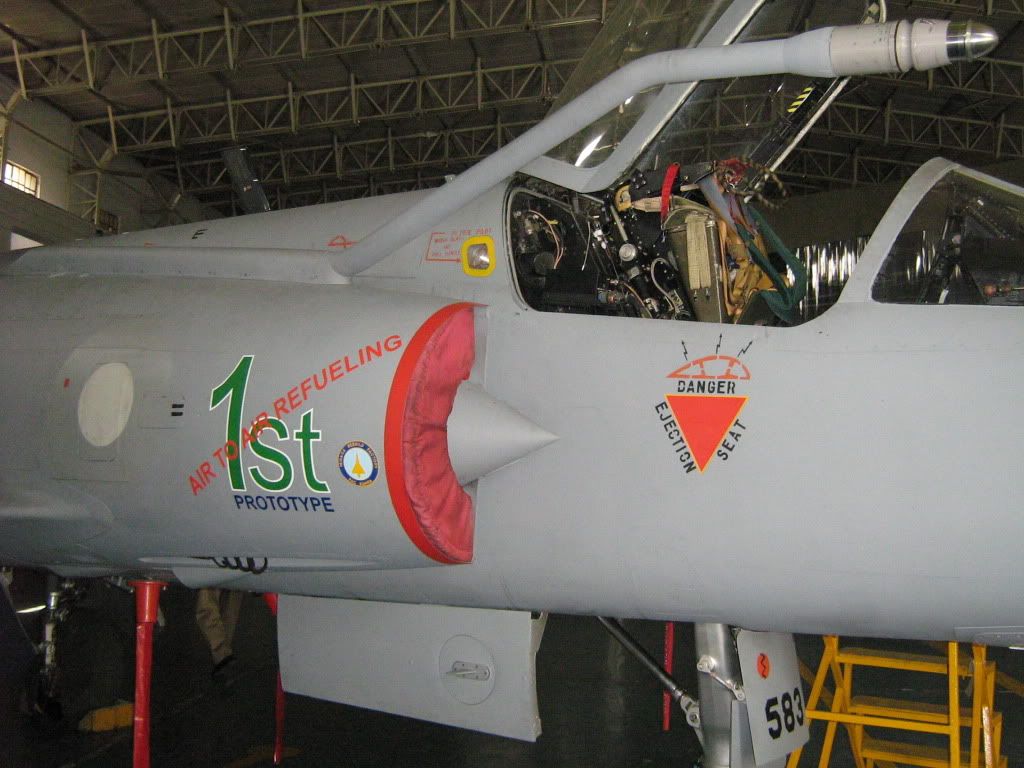
This one is one of ex-Royal Australian Air Force Mirage IIIs acquired by PAF in 1990.

Mirage IIIEA (serial# 90-522)
And this one is one of refurbished ex-French Air Force Mirages acquired by PAF in 1996.
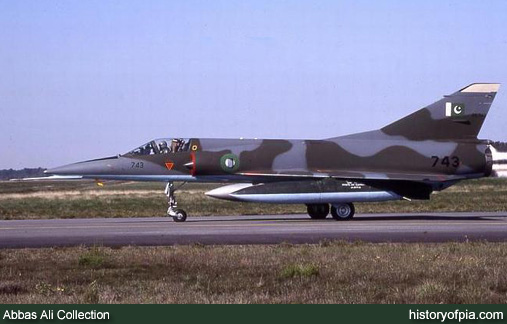
Mirage VEF (serial# 96-743). Note dorsal fin ahead of vertical stabilizer in this model.
The Mirages seen in following photos were among those that were purchased brand new from manufacturer by Pakistan between late 1960s and late 1970s.

Mirage IIIDP (serial# 67-302), two-seater trainer version of Mirage III with slimmer nose.
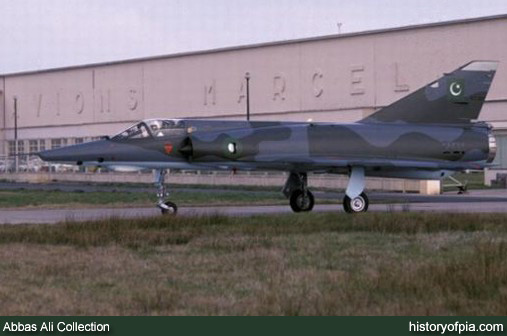
Mirage IIIRP (serial# 67-201). It's reconnaissance version of Mirage III with slimmer nose for cameras.
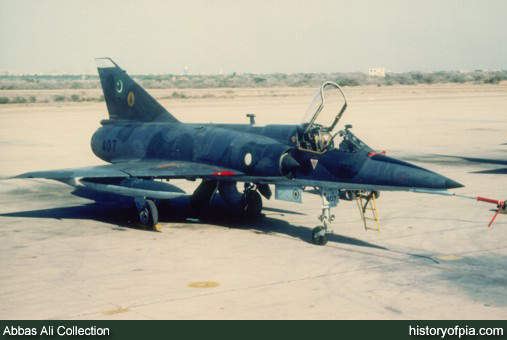
Mirage VPA (serial# 70-407).
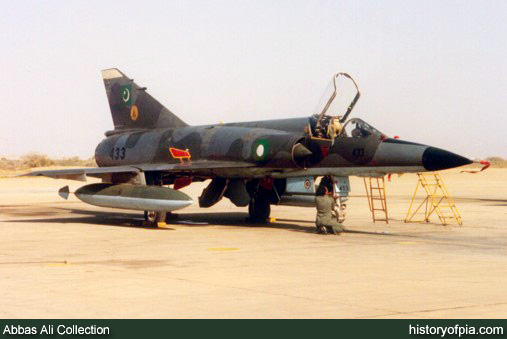
Mirage VPA2 (serial# 79-433).
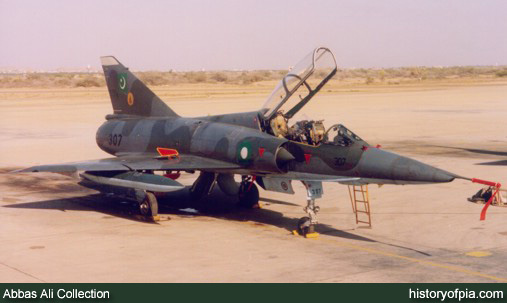
Mirage VDPA2 (serial# 79-307). Two-seater trainer.
yousaf465 wrote:Do we use our reci version any notable mission ?
Taken from article
'PAF Mirages at War', quoted below is information related to missions flown by PAF Mirage IIIRP reconnaissance aircraft before and during 1971 war. The complete article is available for reading at
http://kaiser-aeronaut.blogspot.com/200 ... t-war.html and it provides information about combat missions flown by PAF Mirages including Mirage IIIEP and Mirage IIIRP during 1971 war.
PAF had three Mirage IIIRs, which were equipped with five OMERA Type 31 optical cameras mounted in the nose. With a Doppler navigation radar available, getting to a destination was fairly easy. Magnesium flares provided enough illumination at night to confer a round-the-clock tactical reconnaissance capability. The number of aircraft was, however, on the low side and did not sufficiently cater for unserviceabilities.
A month prior to the outbreak of all-out war, the PAF had started to fly cross-border photo recce sorties, some of which were in the vital Chamb Sector, where the Pak Army’s 23 Division had planned a secondary ‘diversionary’ offensive. With the disposition of forces well-known, the attack resulted in significant advances that threatened India’s overland links to Kashmir, besides depriving Indian forces from establishing a launch pad for offensive operations towards the vital lines of communication passing through nearby Gujrat.
Early in the war, another important breakthrough came in the Suleimanki-Fazilka Sector, where 105 Independent Infantry Brigade (IV Corps) was able to surprise the Indian ‘Foxtrot’ Force and, made a firm foothold in the area of Pak II Corps’ planned main offensive. While the Indian forces desperately carried out repeated counter attacks, PAF Mirages conducted regular photo recce missions in Ferozepur area to update the ground commanders about Indian reinforcement efforts aimed at vacating the incursion. In the event, a badly demoralised and confused Foxtrot Force could not make any headway and the Pakistani brigade was able to safeguard the vital Suleimanki Headworks, which was only a mile from the border.
In preparation for the main offensive, PAF Mirages fervently conducted photo recce missions along Ferozepur-Kot Kapura, Ferozepur-Fazilka and Fazilka-Muktasar railway networks, as well as in general areas of Ferozepur and Sri Ganganagar, for the latest disposition of forces. An important mission involved recce of crossing points over Gang Canal for a careful scrutiny of obstacles across the waterway that could possibly impede the movement of II Corps. The main offensive could, however, not materialise as explained later, and most of the photo recce effort was rendered worthless.
Two pilots who played a sterling role in the photo recce operations were the squadron’s ‘slide rule wizards’, Sqn Ldr Farooq Umar and Flt Lt Najib Akhtar. Of the 30 photo recce sorties (besides 15 escorts) flown by No 5 Squadron before and during the war, 22 were considered successful. Although most of the singleton recce Mirages were escorted by another Mirage, yet some of the missions had to be aborted due to intense enemy air activity. In Shakargarh Sector, a few night recce missions were attempted with partial success. In one such mission on the night of 11 December, an IAF MiG-21 scrambled to intercept a Mirage flown by Sqn Ldr Farooq Umar, ended up shooting down one of its own MiG-21s flown by Flt Lt A B Dhavle, which was patrolling in the vicinity.
Four-odd Bomb Damage Assessment missions were also flown following the initial strikes on runways. These helped in better planning of subsequent airfield strike missions.
Here's painting by Group Captain (retired) Syed Masood Akhtar Hussaini showing PAF Mirage IIIRP (serial# 67-201) over enemy territory during 1971 war.
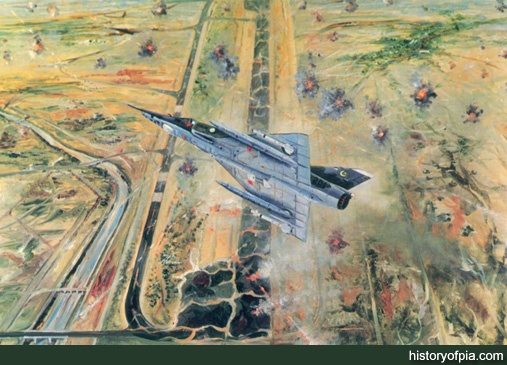 PHOTO STRIKE PATHANKOT - 1445 Hours, 4 December, 1971 -
 Squadron Leader Farooq Umar is manoeuvring and aligning his Mirage fighter recce aircraft to photograph heavily defended and camouflaged Indian Air Force air base at Pathankot.
Abbas